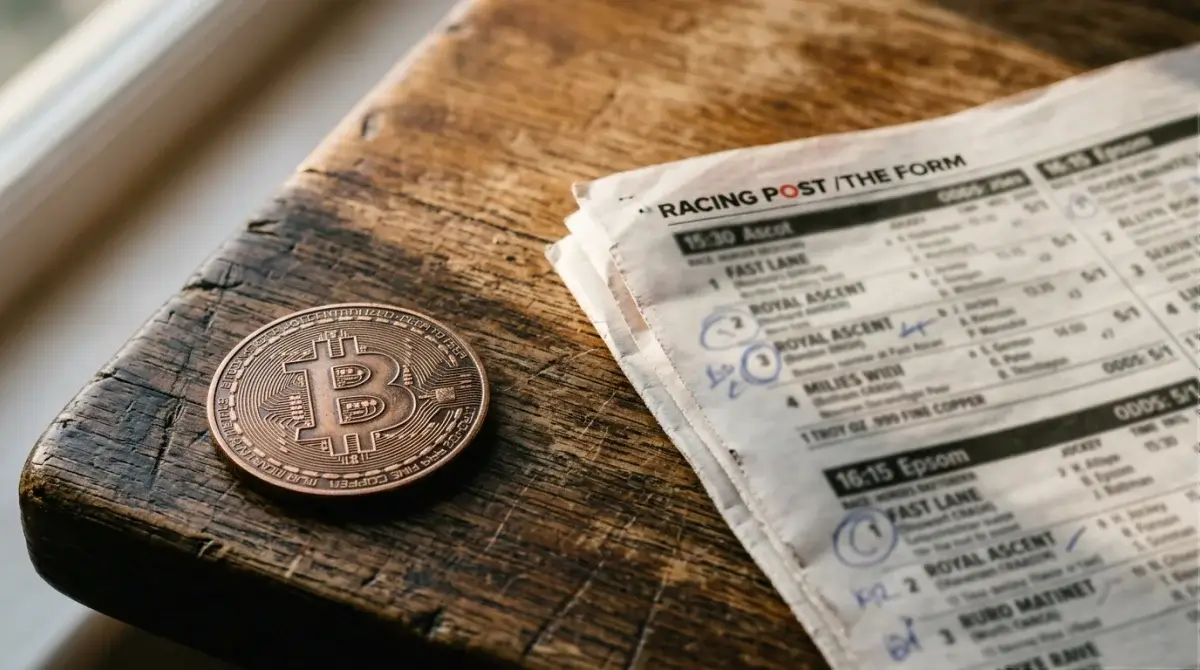
Horse Racing Bet Types With Crypto: Odds, Strategy, Examples
 Available in US
Table of Contents

The bet types available on a crypto racebook are, mechanically, identical to what you would find at any UK bookmaker. A win bet is a win bet whether you stake in USDT or pounds sterling. But the crypto layer adds wrinkles that change how experienced bettors approach their selections – from the impact of withdrawal timing on accumulator payouts to the volatility risk embedded in ante-post wagers denominated in BTC.
Live in-play betting now accounts for 53.4% of all online wagering in early 2026, per DemandSage and CompaniesHistory data. Horse racing’s contribution to that figure is smaller than football’s, but it is growing – and the speed of crypto settlement is accelerating that growth. A punter who can deposit, bet, and withdraw within the span of a single race meeting is operating on a timeline that traditional payment methods simply cannot match.
What follows is every bet type you will encounter at a crypto horse racing sportsbook, with the calculations done in real crypto terms. I am using USDT for the examples because it removes the volatility noise, but the mechanics apply regardless of which coin you use.
Win, Place, and Show Bets in Crypto
My first crypto horse racing bet was a win bet: 50 USDT on a handicapper at Newmarket at decimal odds of 5.00. The horse led from the front, held on by a neck, and my account showed 250 USDT. Simple arithmetic: stake multiplied by odds equals payout. Subtract the original stake and you have a profit of 200 USDT. No currency conversion, no volatility, no waiting for a bank transfer. The entire cycle (deposit, bet, win, withdraw, took less than two hours.
A win bet is the foundation. You pick a horse, it must finish first, and the payout is your stake multiplied by the decimal odds displayed at the time you place the bet. At crypto racebooks, odds are almost universally displayed in decimal format by default, which makes the maths transparent. A horse at 3.50 returns 3.50 times your stake if it wins, including your original stake. Profit equals stake multiplied by (odds minus 1).
Place bets work the same way but with a lower threshold: your horse needs to finish in the top two, three, or four depending on the number of runners and the platform’s place terms. Place odds are derived from the win odds, typically at 1/4 or 1/5 of the win price. So a horse at win odds of 5.00 with 1/4 place terms has place odds of 2.00. Stake 50 USDT, horse places, payout is 100 USDT.
Show bets, where a horse must finish in the top three, are standard in US and Australian racing but less common at crypto racebooks serving UK markets. UK racing traditionally uses place rather than show, and the terms vary by race size. In races with 5-7 runners, place pays for the first two. With 8-15 runners, the first three count. In handicaps with 16 or more runners, the first four. These terms are set by the sportsbook, and I have noticed some crypto platforms simplifying them compared to traditional UK bookmakers – worth checking before you stake.
One thing that separates crypto win bets from their fiat equivalents is the settlement currency. When you win 250 USDT, you know exactly what that is worth in dollar terms. When you win 0.004 BTC, you do not know what that is worth in pound terms until you check the market price at the moment you decide to convert. This introduces a secondary decision that fiat bettors never face: do you withdraw immediately, hold the crypto, or convert to a stablecoin? Each choice carries different implications, and the “right” answer depends on your view of the crypto market as much as your view of the horse.
Each-Way Betting With Cryptocurrency
Each-way is the bread and butter of UK horse racing betting, and it is also where crypto racebooks show the widest variation in quality. An each-way bet is two bets in one: a win bet and a place bet, at half the odds or some fraction thereof. Your total stake is doubled: a GBP 10 each-way bet costs GBP 20.
Let me run through an example in crypto. You fancy a horse at decimal odds of 8.00 in a 12-runner handicap. The platform offers 1/5 place terms for the first three places. You stake 25 USDT each-way, which is 50 USDT total – 25 on the win, 25 on the place.
If the horse wins: the win part pays 25 x 8.00 = 200 USDT. The place part pays at 1/5 of the win odds – that means odds of (8.00 – 1) / 5 + 1 = 2.40. So the place payout is 25 x 2.40 = 60 USDT. Total return: 260 USDT on a 50 USDT stake, for a profit of 210 USDT.
If the horse finishes second or third but does not win: you lose the 25 USDT win part and collect only the place payout of 60 USDT. Total return: 60 USDT on a 50 USDT stake, for a profit of 10 USDT.
If the horse finishes outside the places: you lose both parts, 50 USDT gone.
Here is where it gets important for crypto bettors. Not all crypto sportsbooks offer each-way betting on horse racing. Some only offer win and place as separate bets. Others offer each-way but with worse place terms than you would get at a traditional UK bookmaker. I have seen platforms advertising 1/4 odds for places on races where a UK bookie would offer 1/5 – a material difference. At 1/4 terms on the same 8.00 horse, the place odds drop to (8.00 – 1) / 4 + 1 = 2.75. That sounds better, but “1/4 odds” means the bookmaker keeps more of the edge. Wait – let me clarify. In UK each-way terminology, “1/5 the odds” is worse for the bettor than “1/4 the odds.” Fractions can be confusing. The point is: check the place fraction before you bet, and compare it to what a UK bookmaker is offering on the same race.
The global online horse racing platform market was valued at $360 million in 2025, according to Congruence Market Insights, growing toward $504.2 million by 2033. As that market expands, I expect each-way standards at crypto platforms to converge with traditional UK norms. But right now, the variation is real, and it costs money if you do not check.
Exotic Bets: Exacta, Trifecta, and Forecast Wagers
A friend of mine hit a tricast at Kempton on a crypto platform last winter. Three horses, correct order, combined decimal odds of 412.00. His 10 USDT stake returned 4,120 USDT. The payout hit his wallet in twelve minutes. That story is the appeal of exotic bets in two sentences – life-changing returns on small stakes, settled at crypto speed.
Exacta (known as a forecast in UK terminology) requires you to pick the first two finishers in the correct order. Trifecta (or tricast) extends that to the first three in order. These are high-risk, high-reward wagers that rely on precision rather than probability. The odds are not fixed by the bookmaker in the traditional sense; on most platforms, exacta and trifecta payouts are determined by a pool or dividend system, or by combining the individual runners’ odds.
Reversed exacta, sometimes called a reverse forecast, covers both possible orders of two selected horses. Your stake doubles because you are effectively placing two exacta bets. If you pick horses A and B, you win if A finishes first and B second, or B first and A second. The payout is lower than a straight exacta because you have halved your risk, but the convenience appeals to bettors who like two horses but are unsure about the order.
Here is the challenge for crypto bettors: exotic markets are the least consistently available bet type at crypto sportsbooks. My testing over the past year shows that fewer than half of the platforms with horse racing coverage offer forecast or tricast betting on UK races. Those that do often limit it to larger meetings, Group races, festival cards, rather than offering it across the full daily card. If exotic bets are central to your racing strategy, this narrows your platform options significantly.
Accumulator bets (parlays in US terminology) chain multiple selections together, with the winnings from each rolling into the next. A four-fold accumulator at decimal odds of 3.00, 2.50, 4.00, and 2.00 on four different races pays 3.00 x 2.50 x 4.00 x 2.00 = 60.00 times your stake. A 10 USDT bet returns 600 USDT if all four horses win. The appeal is obvious; the risk is that a single losing leg kills the entire bet. For a deeper look at multi-leg strategies, the crypto accumulator bets on horse racing guide covers the mechanics and risk management in detail.
In-Play and Live Horse Racing Bets With Crypto
A flat race at Ascot lasts ninety seconds to two and a half minutes. A two-mile hurdle at Cheltenham takes three to four minutes. That is the entire window for in-play horse racing betting – and it is why the speed advantage of crypto matters more here than in any other sport.
Live betting on horse racing at crypto sportsbooks is growing but remains limited compared to football or tennis in-play markets. The typical offering is a win market that stays open until the stalls open or shortly after, with odds adjusting based on pre-race movement in the ring. Some platforms extend in-play to the running of the race itself, but the market depth thins dramatically once the horses are off. You will find win-only markets, occasionally place, and almost never exotics during live play.
AI-adjusted odds are changing this space. AI algorithms can reprice odds up to 35% faster than traditional statistical models, according to Congruence Market Insights. For in-play horse racing, speed of repricing determines how quickly the platform can respond to changes – a horse that stumbles at the first fence, a pace collapse in the final furlong. The platforms investing in AI-driven odds engines are the ones offering the deepest live racing markets. Subarna Biswas at Bitzo frames the broader trend: instant settlement is becoming the standard, not the exception. When your bet settles in seconds rather than minutes, the in-play cycle tightens, and platforms can offer more granular markets within the race window.
The practical consideration for crypto bettors is that live horse racing bets settle from your custodial balance on the platform, not from your blockchain wallet. You are not sending a transaction on-chain when you click “place bet” during a race – the bet executes internally, against your deposited balance. This means the speed of on-chain transactions is irrelevant for live bet placement. What matters is that you pre-fund your account before racing starts. The crypto speed advantage kicks in on the deposit side – getting funds onto the platform fast enough to participate – and on the withdrawal side, getting winnings out quickly after the last race.
Ante-Post Betting: Long-Term Horse Racing Wagers in Crypto
In January 2026, I placed an ante-post bet on a Grand National contender at 25.00. The horse was still in training, the entries had not been finalised, and the race was four months away. I used USDT. If I had used BTC, the currency would have moved at least 20-30% in either direction by April. The horse pulled up at the third fence – I lost the bet on its merits. But at least I lost exactly what I staked, without a currency swing adding insult to injury.
Ante-post betting is where you back a horse weeks or months before a race, typically at much longer odds than you would get on race day. The trade-off is clear: better odds in exchange for the risk that the horse does not run. Most ante-post bets are “non-runner, no bet” up to a certain date and “all in, run or not” closer to the race. This varies by platform and by event. The global horse racing market, valued at $491.7 billion in 2025 per Deep Market Insights, generates a significant portion of its betting turnover from ante-post speculation on major events.
For crypto bettors, the unique consideration is the holding period. An ante-post bet placed in January for a race in April means your stake sits on the platform for three months. If that stake is in BTC, you are exposed to Bitcoin’s price volatility for the entire period. Even if you win the bet, a BTC decline over those months could wipe out the profit. I consider ante-post in BTC to be a double speculation, on the horse and on the currency, and I do not do it.
Stablecoins resolve the issue completely. A 100 USDT ante-post bet retains its dollar value whether the race is tomorrow or six months away. Your profit or loss from the wager is purely a function of whether the horse wins, not whether the crypto market had a bad quarter. For ante-post betting specifically, there is no reasonable argument for using a volatile cryptocurrency when stablecoins are available.
Odds Formats at Crypto Racebooks: Decimal, Fractional, American
If you have spent your life reading fractional odds on UK racing (5/1, 7/2, 11/4), the default decimal display at crypto sportsbooks takes some adjustment. But only some. Decimal odds are arguably clearer: the number shown is exactly what you get back per unit staked, including your stake. A horse at 6.00 in decimal is 5/1 in fractional. Your 10 USDT returns 60 USDT. No mental conversion needed.
American odds appear at some crypto platforms but are rare for horse racing outside the US market. The plus/minus format (+500 means you profit 500 on a 100 stake, -150 means you stake 150 to profit 100) is intuitive for US bettors but unfamiliar to most UK punters. I have never needed to use American odds at a crypto racebook offering UK racing.
The more important issue is not the format but the conversion accuracy. Most crypto racebooks allow you to toggle between decimal and fractional display. Some do this conversion imprecisely, rounding in ways that obscure the true odds. I have seen a horse displayed at 3.40 in decimal (which should be 12/5 in fractional) shown as 7/2 (3.50 decimal) in the fractional view. That 0.10 difference might seem trivial, but across hundreds of bets, it compounds. Always verify the actual payout by checking the decimal odds, regardless of which format you prefer to read.
One quirk of crypto racebooks: some platforms set odds in USD terms rather than GBP, which can create subtle discrepancies for UK bettors. If a horse is priced at 4.00 and you stake 100 USDT, your return is 400 USDT regardless of the GBP/USD rate. But if you are mentally converting to pounds and the rate has moved since your deposit, the “real” return in GBP terms is different from what you expected. This is a stablecoin-specific issue; BTC bettors face the same problem magnified by volatility. The cleanest approach is to think in crypto terms while betting and only convert to GBP when you withdraw.
Do crypto racebooks offer the same each-way terms as traditional UK bookmakers?
Not always. Most crypto sportsbooks support each-way betting on horse racing, but the place terms can differ from what UK punters expect. Some crypto platforms default to 1/4 across all races regardless of field size, while others match UK conventions. Check the specific place terms displayed on the bet slip before staking – the difference between 1/4 and 1/5 on a 10/1 shot changes your place return significantly.
Can I place an in-play bet on a horse race using Bitcoin?
Yes, provided you already have BTC credited to your account balance. In-play bets are placed from your on-site balance, not from a live blockchain transaction. The deposit must be completed before the race begins. The challenge with BTC is deposit timing: if you need to top up during a meeting, network confirmation delays could mean missing several races. Stablecoins on faster networks like USDT via TRC-20 offer much shorter deposit windows.
How are trifecta payouts calculated in cryptocurrency?
Trifecta payouts at crypto racebooks follow the same logic as fiat sportsbooks. On a pool-based trifecta, the payout depends on how much money is in the pool and how many winning tickets there are. The key difference is denomination: your payout arrives in whatever crypto you used to stake. If you bet 50 USDT and the trifecta returns 200-to-1, you receive 10,000 USDT. For BTC bets, the fiat equivalent depends on the price at withdrawal, making stablecoins preferable for high-value exotic wagers.
Which odds format do most crypto horse racing platforms use by default?
Decimal odds are the default at the vast majority of crypto racebooks, reflecting the international nature of these platforms. Most allow you to switch to fractional odds in the settings, which is more familiar for UK bettors. Check the settings immediately after registering and switch to your preferred format before browsing markets, because reading odds in an unfamiliar format increases the chance of miscalculating a bet.
Learn more about horse racing crypto betting on our main page.
You may also find Levy Board and Crypto Horse Racing Funding: Where Your Bets Go interesting.
Published by the Horse Racing Crypto Betting team.