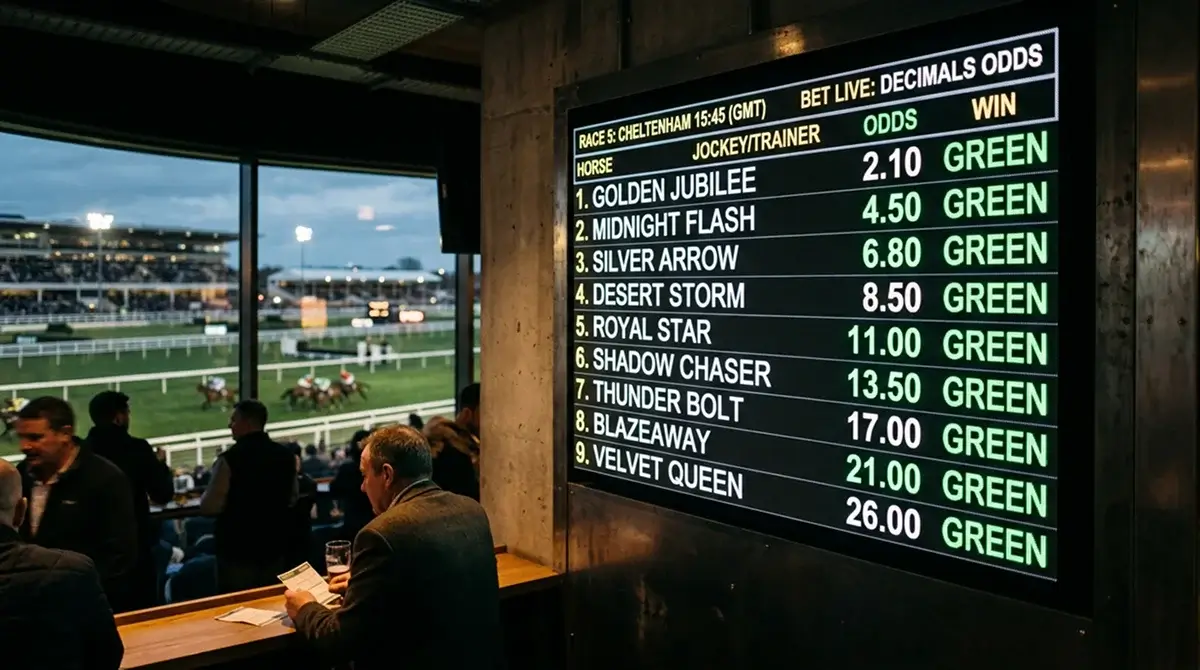
Crypto Betting on the Cheltenham Festival: Jump Racing’s Biggest Week
 Available in US

Cheltenham Festival is the week that defines National Hunt racing. Four days, twenty-eight races, and a collective intensity that no other UK meeting matches. Over 280,000 people attended across the 2025 Festival, and the betting volume dwarfs any other jump racing fixture by an order of magnitude. Turnover per race at Premier meetings like Cheltenham increased 2.7% in 2025 even as overall horse racing turnover declined, per BHA data – further evidence that money is concentrating at the top of the racing calendar.
I have bet on every Cheltenham Festival since 2019, switching to crypto in 2022. The four-day format creates specific challenges and opportunities for crypto bettors that differ from a single-day meeting like the Grand National or a flat festival like Royal Ascot. Cheltenham demands sustained engagement, bankroll management across multiple days, deposit timing around congested mobile networks, and ante-post strategies that span weeks of market movement before the first race.
Ante-Post Crypto Betting for Cheltenham
Ante-post markets for Cheltenham open months before the Festival, with odds available on the Champion Hurdle, Gold Cup, Queen Mother Champion Chase, and Stayers’ Hurdle from mid-autumn onwards. For crypto bettors, ante-post offers a structural advantage: there is no time pressure. You have days or weeks to find the best price across multiple platforms, and blockchain confirmation speed is irrelevant when the race is still weeks away.
The practical benefit of using crypto for ante-post Cheltenham bets is the ability to spread selections across multiple racebooks without the friction of maintaining funded accounts at each one. USDT on TRC-20 moves between platforms in under a minute, deposit at one racebook, take the 12/1 about the Gold Cup favourite, move the remaining USDT to a second racebook where the Champion Hurdle ante-post price is a point longer. This agility across platforms is something that fiat bettors, tied to individual account balances and bank transfer timescales, struggle to replicate.
The risk unique to ante-post crypto betting is platform stability over time. An ante-post bet placed in November settles in March. If the racebook ceases operations between those dates, the bet and any deposit balance disappear with it. For ante-post positions at crypto racebooks, I mitigate this by limiting exposure per platform, no more than 5% of my total Festival bankroll with any single operator, and by favouring platforms with established track records over newer entrants offering longer odds.
Managing a Four-Day Crypto Bankroll
Cheltenham’s format tests bankroll discipline in ways that single-day meetings do not. Seven races per day across four days means twenty-eight betting opportunities – more if you count in-play markets and each-way variations. A bettor who burns through their bankroll on Tuesday’s card has nothing left for the Gold Cup on Friday. The emotional momentum of the Festival – the crowd energy, the avalanche of tipping content, the pressure to have a bet in every race – makes disciplined staking harder than it sounds.
Subarna Biswas of Bitzo observed in 2025 that instant payout has become the new industry standard. For Cheltenham, that speed is a double-edged sword. Quick withdrawals allow you to pull profits off the platform after a winning day. Quick deposits allow you to top up after a losing day without any cooling-off period. The temptation to reload after a bad Tuesday and try to win it back on Wednesday is amplified by the ease of a thirty-second USDT transfer.
My Cheltenham bankroll structure allocates the total Festival budget into daily segments – roughly 30% for the first two days combined and 35% each for Thursday and Friday, reflecting the increasing quality of racing as the week progresses. Thursday’s card typically features the Stayers’ Hurdle and the Ryanair Chase, while Friday brings the Gold Cup and the Triumph Hurdle. These are the races where form analysis offers the most edge, and preserving ammunition for them is more important than having action in every race on the opening day.
I hold the full Festival bankroll in a personal USDT wallet and deposit each day’s allocation to the racebook on the morning of that day. This creates a hard limit on daily exposure. I cannot bet more than the day’s allocation without making a conscious decision to override the plan, which requires opening the wallet app and initiating a new transaction. The minor inconvenience is the point: it converts an impulse into a deliberate action.
Platform Preparation and Mobile Readiness
Cheltenham punishes under-preparation. The racecourse sits in a natural amphitheatre with limited mobile network infrastructure relative to the crowd size, and data speeds at peak times – the half-hour before the first race, the interval between the second and third races – can drop to levels that make page loading unreliable. I have had deposit confirmations delayed not because of blockchain congestion but because my phone could not maintain a stable connection to the racebook’s server.
Pre-funding solves most of this. Deposit your day’s allocation before you leave for the course, or at the very latest, before you enter the grounds. Once inside, treat your funded platform balance as your working capital and avoid any on-chain transactions until you are back on a reliable connection. If you need to check your wallet balance or verify a transaction, screenshot it beforehand or use a secondary device on a different network.
The stablecoin market now exceeds $250 billion in total capitalisation, per PlayToday data from 2025, and USDT dominates crypto betting volumes. For Cheltenham, USDT’s dollar peg eliminates the currency risk that would otherwise add an unwanted variable across four days of exposure. A BTC-denominated bankroll could gain or lose 3-5% over the course of the Festival independent of your betting results – and explaining to yourself that a profitable week of selections actually lost money because Bitcoin dropped is a conversation best avoided.
Reading the Cheltenham Market Across the Week
Cheltenham’s market dynamics evolve across the four days in a pattern that crypto bettors can exploit with cross-platform agility. Tuesday’s card generates the week’s first wave of information: which trainers’ horses are running well, how the ground is riding, whether the pace bias favours front-runners or closers. By Wednesday morning, the market has absorbed that information and repriced accordingly.
Crypto bettors with funded accounts at multiple racebooks can shop for the best available odds across platforms within minutes. A horse that drifts from 8/1 to 10/1 at one racebook while holding at 8/1 elsewhere represents a clear value opportunity, and the speed of USDT transfers means you can fund whichever racebook offers the best price without advance planning. This is not a theoretical advantage. At the 2025 Festival, I identified a two-point price discrepancy on a Thursday runner across two crypto platforms and placed the bet at the longer price within four minutes of spotting it, including the deposit transfer time.
The Festival’s intensity rewards bettors who approach it as a marathon rather than a sprint. Save your largest stakes for the races where your analysis is strongest, maintain discipline across the mid-week sessions, and use crypto’s cross-platform speed to capture the best available prices. Cheltenham is the ultimate test of whether your understanding of odds and value translates from theory into practice under the pressure of the biggest week in jump racing.
Should I place ante-post bets on Cheltenham with crypto months in advance?
Ante-post offers genuine value when you identify a horse whose price will shorten as the Festival approaches. The key risk for crypto bettors is platform stability – an ante-post bet placed in November settles in March, so the racebook must remain operational throughout that period. Limit ante-post exposure per platform and favour established operators over newer platforms offering marginally longer odds.
How much of my crypto bankroll should I allocate to each day of Cheltenham?
A common approach allocates less to the opening days and more to Thursday and Friday, where the feature races attract the strongest form and the deepest markets. A split of roughly 30% for Tuesday and Wednesday combined, with 35% each for Thursday and Friday, preserves capital for the Gold Cup card and reduces the risk of exhausting your bankroll before the biggest races.
Find the best options for horse racing crypto betting.
Read our detailed review of Crypto Betting on the Grand National: UK’s Biggest Race.
Written by the editors at Horse Racing Crypto Betting.