
Provably Fair Horse Racing Betting: How Verification Works
 Available in US
Blockchain-based settlement systems are projected to reduce transaction errors by 22% by 2028, according to Congruence Market Insights. That statistic applies to financial settlement broadly, but the underlying principle – that cryptographic verification eliminates categories of error and manipulation – is precisely what provably fair technology brings to betting. The concept is simple in theory: every outcome can be independently verified by the bettor after the fact, using mathematical proof rather than trust. In practice, applying provably fair mechanics to horse racing introduces complications that most explainers gloss over.
I first tested a provably fair system on a crypto dice game, where the application is straightforward, the outcome is generated algorithmically, so the entire process from seed to result can be hashed and verified. Horse racing is fundamentally different. The outcome is determined by real horses on a real track, not by a random number generator. That distinction changes everything about how provably fair technology applies, and understanding the difference is essential before you trust any platform’s “provably fair” marketing.
How Provably Fair Works: Seeds, Hashes, and Verification
Tim Miller, the UK Gambling Commission’s Executive Director of Research and Policy, described innovation as a central consumer protection tool when addressing the industry in early 2026. Provably fair technology is the clearest example of this principle in action, it shifts verification power from the operator to the bettor.
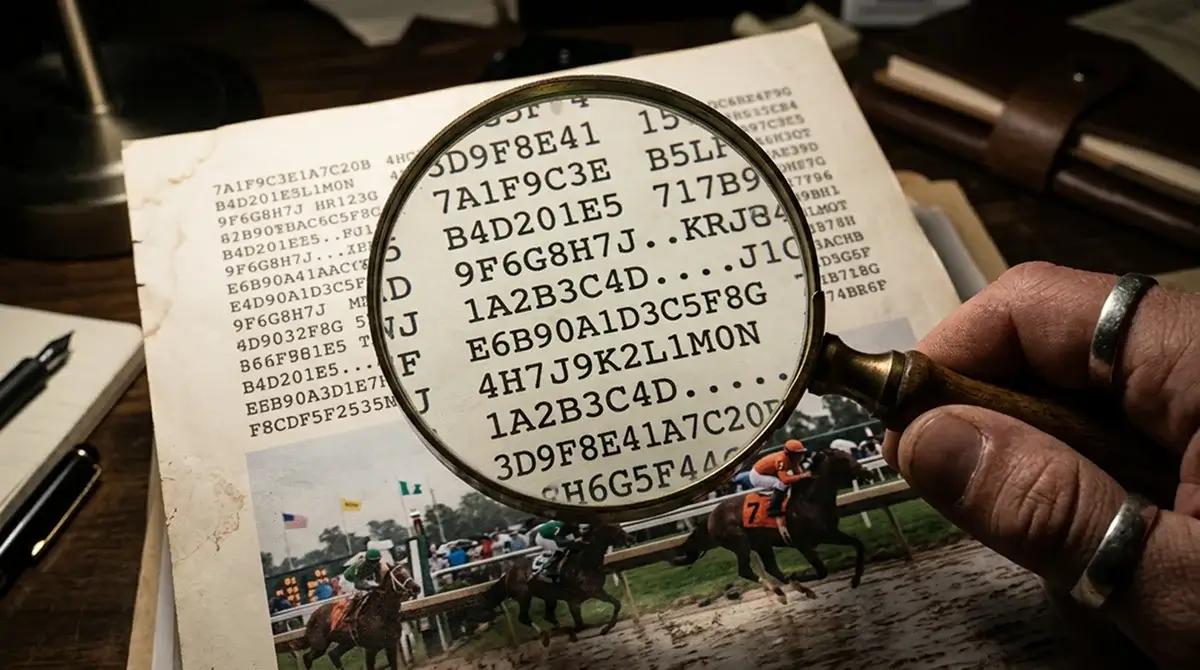
The mechanics work through cryptographic hashing. Before a betting round begins, the platform generates a server seed, a random string of characters, and publishes its hash. A hash is a one-way mathematical function: given the seed, anyone can compute the hash, but given only the hash, no one can reverse-engineer the seed. The bettor contributes a client seed, which combines with the server seed to determine the outcome. After the round ends, the platform reveals the original server seed. The bettor can then hash it independently and confirm it matches the hash published before the round started. If it matches, the outcome was determined before the bet was placed and was not altered after the fact.
For a non-technical bettor, think of it as a sealed envelope. The platform writes the answer on a piece of paper, seals it in an envelope, and shows you the envelope before you bet. After the round, the envelope is opened. If the answer on the paper matches the result, you know the answer was set before your bet, the platform could not have changed it in response to your wager. Cryptographic hashing is the mathematical equivalent of this sealed envelope, except it is impossible to forge, and anyone with the seed and the hash function can verify it independently.
Verification tools are typically built into the platform’s interface – a “verify” button next to each resolved bet that shows you the server seed, client seed, combined hash, and the resulting outcome. More security-conscious bettors can run the verification through third-party tools or their own scripts, confirming that the platform’s calculation matches an independent computation.
Provably Fair Applied to Real Horse Races vs Virtual Races
Here is where the concept collides with reality. Crypto casinos now constitute approximately 17% of all iGaming globally, per Surgence Labs data, and provably fair technology works elegantly for the casino side, slots, dice, roulette, card games, because those outcomes are generated by the platform’s own random number generator. The RNG output is the outcome, so the entire chain from seed to result can be verified cryptographically.
Real horse racing breaks this model. The outcome of the 3:15 at Kempton is determined by biological and physical factors, the fitness of the horse, the skill of the jockey, the condition of the ground, the tactical decisions made during the race. No server seed determines whether the favourite wins or the outsider causes an upset. The result is external to the platform, which means the seed-to-outcome verification that defines provably fair technology cannot cover the race result itself.
What provably fair can cover in real horse racing is the integrity of the betting process around the result. A provably fair racebook can prove that the odds offered to you at the moment of bet placement were set before your bet and were not adjusted after the fact. It can prove that the settlement calculation, your stake multiplied by the agreed odds, was executed correctly. It can prove that the result fed into the settlement system matches the official result from the racing authority. These are meaningful protections against operator manipulation, but they are not the same as proving the race outcome itself was fair.
Virtual horse racing is a different matter entirely. RNG-powered virtual races are algorithmically generated, which means the full provably fair chain applies: the server seed determines the outcome, the hash commits to it before the bet, and the bettor can verify everything after the race. If provably fair verification matters to you and you are choosing between real and virtual horse racing at a crypto site, virtual races offer the more complete implementation of the technology.
Which Crypto Racebooks Offer Provably Fair Features?
The honest assessment of the current landscape is that provably fair horse racing betting on real races is rare, and where it is marketed, the claims need careful examination. Most crypto racebooks that advertise “provably fair” are referring to their casino products, slots, crash games, dice, rather than their sportsbook or horse racing sections. The sportsbook side typically operates on the same trust-based model as a traditional bookmaker: you trust the platform to offer accurate odds, settle bets correctly, and process payouts honestly.
A handful of decentralised prediction market protocols are building systems where the odds, stakes, and settlement are recorded on-chain in a verifiable manner, as explored in our coverage of smart contract betting. These come closest to provably fair horse racing in the meaningful sense, not proving the race result, which is external, but proving every aspect of the betting transaction that is within the platform’s control.
When evaluating a crypto racebook’s provably fair claims, ask three specific questions. First, does the provably fair system cover the sportsbook and horse racing markets, or only the casino products? Second, what exactly is being proven, the outcome generation, the odds integrity, or the settlement calculation? Third, can you verify independently using third-party tools, or must you rely on the platform’s own verification interface? The answers will tell you whether “provably fair” is a genuine technical feature or a marketing term borrowed from the casino side of the business.
Can provably fair technology guarantee a horse race result is not fixed?
No. Provably fair technology verifies that the platform’s internal processes – odds setting, bet recording, payout calculation – were conducted fairly and were not altered after the fact. The race result itself is determined by external, real-world factors that no cryptographic system can control or verify. Race integrity is the responsibility of racing authorities and stewards, not of the betting platform’s technology stack.
How do I verify my bet was settled correctly on a provably fair crypto racebook?
Platforms with provably fair features typically provide a verification tool showing the server seed, client seed, combined hash, and the calculation that produced the settlement. You can confirm that the pre-committed hash matches the revealed server seed and that the payout calculation follows the stated rules. For independent verification, copy the seeds and run them through the same hash function using third-party tools or your own script.
Learn more about horse racing crypto betting on our main page.
You may also find Responsible Gambling and Crypto Horse Racing: Staying in Control interesting.
Written by the editors at Horse Racing Crypto Betting.