Live Horse Racing Betting With Crypto: In-Play Markets Guide
 Available in US
Live betting now accounts for 53.4% of all online wagering activity as of early 2026, per DemandSage data. That number makes sense for football, where a match runs ninety minutes and market shifts unfold gradually. For horse racing, it is a different animal entirely. A flat race lasts sixty to ninety seconds. A two-mile hurdle might give you four minutes. The window between “I see an opportunity” and “the race is over” is brutally short, and the technology behind your bet, how fast the platform accepts it, how quickly your crypto balance refreshes, determines whether you act on that opportunity or watch it disappear.
I have placed in-play bets on horse racing across six different crypto platforms over the past two years. The experience ranges from seamless to infuriating, and the gap between the best and worst is wider than most bettors expect.
In-Play Markets for Horse Racing at Crypto Sites
The first surprise for anyone moving from a traditional UK bookmaker to a crypto racebook is how shallow in-play horse racing markets tend to be. Most crypto platforms offer live win markets on major UK and Irish fixtures, the kind of card you get on a Saturday at Newbury or Leopardstown. Some extend that to place markets. Very few offer in-play each-way, forecast, or exotic bets during a live race.
Compare that to football, where a crypto sportsbook might list forty or fifty in-play markets per match – next goal, corners, cards, booking points, player shots. Horse racing’s in-play offering is sparse by design. The race is too short for complex markets, and the risk to the bookmaker shifts too fast. When a horse stumbles at the second-last in a steeplechase, the entire win market reprices in half a second. Platforms that cannot adjust that quickly simply suspend betting, which means the in-play window effectively closes mid-race.
What works well is pre-race in-play, the period between the horses loading into the stalls or lining up at the tape and the moment the race begins. This is where traditional exchange markets see the heaviest volume, and several crypto racebooks now keep their markets open through this phase. Odds move rapidly as late information filters through – a horse sweating up, a jockey change, ground conditions shifting – and the bettors who pay attention to the paddock feed gain a genuine edge.
Latency and Transaction Speed for Live Crypto Bets
Subarna Biswas of Bitzo put it plainly in 2025: instant payout is no longer a luxury but the new industry standard. For live horse racing bets, that expectation extends to the placement side too. If your platform takes three seconds to confirm a bet placement while odds are moving every half-second, you are not getting the price you saw when you tapped the button.
Latency in live crypto betting comes from three layers. The first is the platform’s own infrastructure – server response time, odds-engine recalculation speed, and bet acceptance logic. The best crypto racebooks process a live bet placement in under one second. The worst take three to five seconds and frequently reject bets because the odds moved during processing.
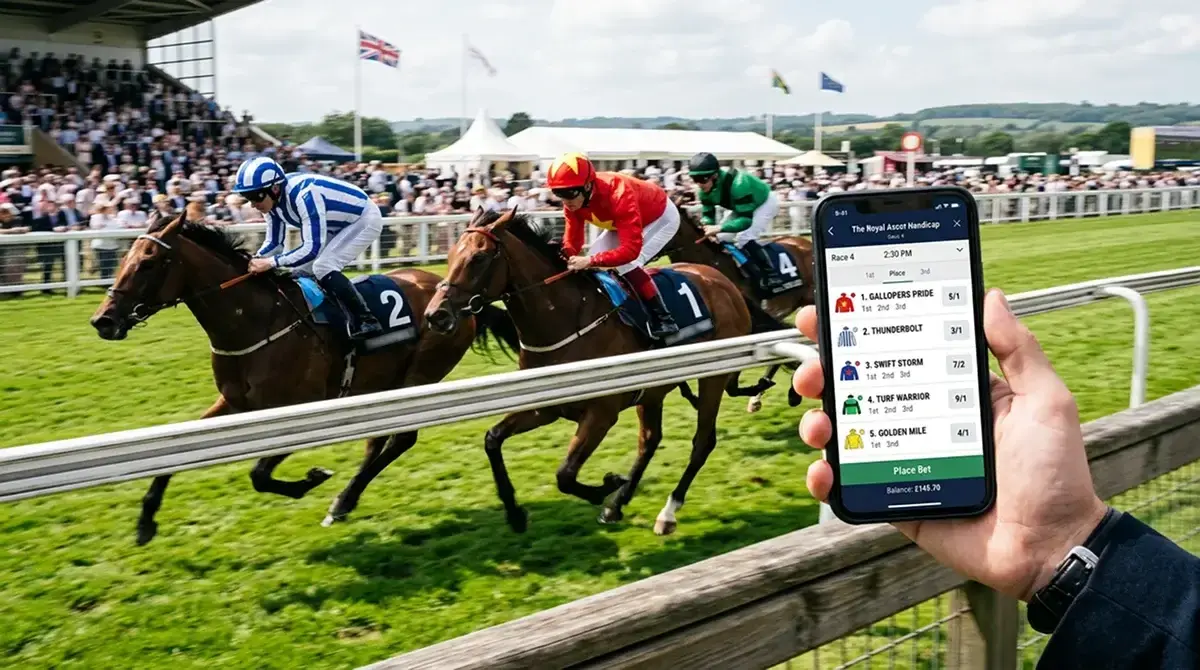
The second layer is the bettor’s connection. A mobile data signal at the racecourse itself can be congested, especially at major meetings where ten thousand people are competing for bandwidth. I learned this the hard way at Cheltenham in 2024, where my in-play bet timed out twice before the third race. A pre-loaded stablecoin balance on the platform eliminates one variable, there is no on-chain transaction happening at the moment of bet placement, because the funds are already credited to your account. The blockchain only matters at deposit and withdrawal, not during the live bet itself.
The third layer is the stream delay. Every live video feed arrives a few seconds behind the actual race. A broadcast delay of three to ten seconds is standard. If you are watching a race on a crypto platform’s embedded stream and reacting to what you see, you are reacting to something that already happened three seconds ago at the racecourse. This delay is built into the odds engine’s calculations, which is why the platform can often accept your bet, the house knows the result of the last three seconds before you do. Bettors at the track with their own eyes on the race have a latency advantage that no technology eliminates.
AI-adjusted odds are narrowing that gap from the platform’s side. Models that reprice odds 35% faster than traditional statistical approaches, per Congruence Market Insights data, allow racebooks to keep markets open deeper into a race. For bettors, this means more chances to act – but against a smarter counterparty. If you want to take live betting onto your phone at the racecourse, understanding these latency layers matters more than any tipping service.
Live Streaming at Crypto Racebooks: Coverage and Quality
Not every crypto racebook that offers in-play horse racing markets also offers a live stream. And not every stream that exists is worth watching. I have encountered feeds that were thirty seconds behind the race, feeds that cut out mid-race during peak traffic, and one platform that streamed harness racing from South America as its only “live horse racing” content.
The platforms that do stream UK and Irish racing typically source their feeds from SIS or Racing TV, the two main providers. Quality is usually adequate for following the race, though resolution drops noticeably on mobile devices. The key question is whether the stream is genuinely integrated with the betting interface – can you tap an odds button while watching, or do you need to switch screens? The best implementations overlay the bet slip on the stream. The worst require you to leave the stream entirely, navigate to a separate markets page, and hope the odds have not shifted by the time you arrive.
For serious in-play racing bettors, I still recommend a second screen setup: the crypto racebook’s bet slip on your phone, and a dedicated racing stream from an independent source on a tablet or laptop. This splits the latency problem, the best available stream on one device, the fastest bet placement on another.
Making Live Crypto Bets Work for Horse Racing
Live betting on horse racing with crypto is not for everyone. The windows are narrow, the markets are thinner than football, and the latency stack works against mobile-only users at crowded racecourses. But for bettors who understand the constraints and prepare accordingly, pre-loaded stablecoin balances, dual-screen setups, familiarity with the platform’s bet acceptance speed, there is genuine value in the pre-race and early-race windows where prices move ahead of general market awareness. The key is knowing which moments favour the bettor and which favour the house.
Can I place a live bet on a horse race during the final furlong?
In most cases, no. The majority of crypto racebooks suspend in-play markets during the final stages of a race because the odds shift too rapidly for accurate real-time pricing. Some platforms keep markets open longer than others, but reliable bet acceptance in the final furlong is rare. The most consistent in-play opportunity is the pre-race window between loading and the off.
Do crypto racebooks offer live streaming of UK horse racing?
Some do, sourcing feeds from providers like SIS or Racing TV. Coverage varies by platform – a few stream most UK and Irish cards, while others limit live video to major meetings or rely on international racing content. Check whether the stream integrates directly with the betting interface, as split-screen implementations perform better for in-play wagering than platforms that separate streaming from the bet slip.
Find the best options for horse racing crypto betting.
Read our detailed review of Mobile Crypto Horse Racing Betting: Apps, Browsers, and On-Course Use.
Created by the ”Horse Racing Crypto Betting” editorial team.